 neonency
Elementor vs custom theme: which one should you choose?
Editing freedom versus speed and control. An honest comparison from someone who builds both, and a simple way to decide.

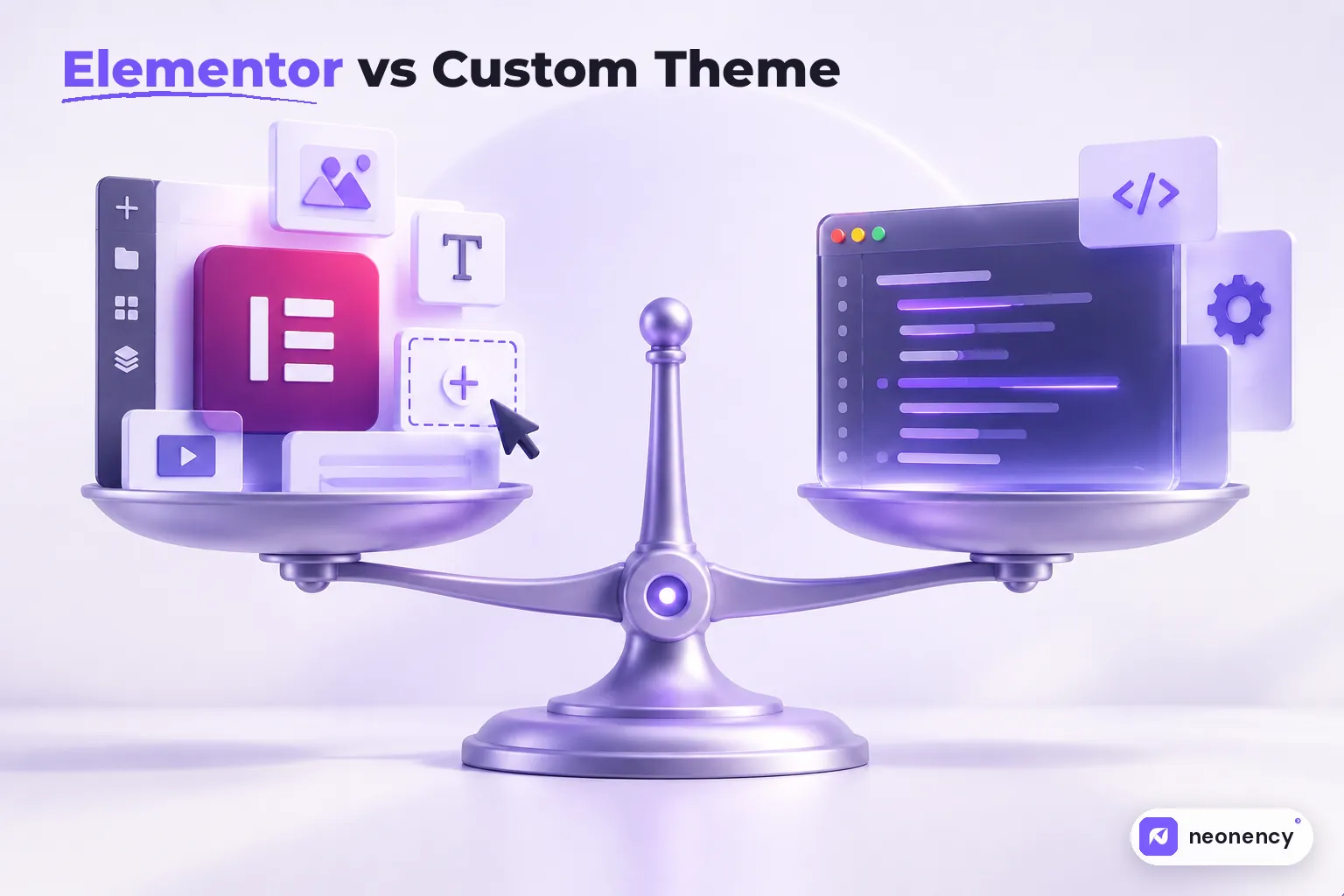
Choose Elementor if your team wants to build and change page layouts visually without a developer. Choose a custom theme if speed, clean code and long term control matter most and your team mostly edits content, not layouts. Both can rank well on Google. The deciding question is who will edit the site and how often.
I build sites both ways. Some weeks it is Elementor all day, other weeks it is a custom theme with not a single page builder in sight. So when someone asks me "which is better," my honest answer is that I have been asked the wrong question.
The better question is: who is going to edit this website, and what will they need to change? Answer that, and the choice usually makes itself.
What we are actually comparing
Elementor is a visual page builder for WordPress. You drag widgets onto the page, like headings, images, buttons and forms, and style them without writing code. It has a free version and a paid Pro version with more widgets and a theme builder for headers, footers and templates.
A custom theme is built by a developer specifically for your site. The design is turned into clean templates, and editable content is usually set up with the block editor or custom fields. Editors fill in content, while the layout itself is controlled in code.
Side by side
| Elementor | Custom theme | |
|---|---|---|
| Editing | Change layouts visually, no code | Edit content in fields or blocks, layout changes need a developer |
| Speed | Good with care, heavier by default | Fast by default, only loads what it needs |
| Build cost | Usually lower | Usually higher upfront |
| Ongoing cost | Pro license plus add ons | Fewer licenses, developer time for changes |
| Flexibility | Huge for layouts, limited by widgets for logic | Anything you can code |
| Risk | Plugin conflicts, messy layouts if many people edit | Dependence on the developer who built it |
| Best for | Marketing teams, landing pages, frequent redesigns | Performance focused sites, complex features, strict brands |
When Elementor is the right choice
Elementor shines when the people running the website want freedom. Marketing teams that launch new landing pages every month, small businesses that want to tweak their homepage without opening a ticket, agencies that hand sites over to clients who like to experiment.
It is also fast to build with, which keeps costs down. For many small business sites, that is the sensible choice.
The catch is discipline. Elementor gives everyone the power to add one more section, one more animation, one more widget add on. Six months later the page has 40 nested containers and loads three slider libraries. I have cleaned up plenty of those.

To keep an Elementor site fast and tidy:
- use global colors and fonts instead of styling widgets one by one
- build reusable templates for repeated sections
- keep the number of add on plugins small
- turn on Elementor's performance features and test them
- pair it with good hosting and caching, as covered in my WordPress speed guide
When a custom theme is the right choice
A custom theme makes sense when performance and control matter more than layout freedom. Content heavy sites, sites with complex features, brands with strict design rules, or businesses where the website must be as fast as possible on mobile.
Editors still have an easy time. They update text, images, services, team members and blog posts through clear fields. They just cannot accidentally break the layout, which some clients see as a feature, not a limitation.
The real risk is dependence. If a custom theme is poorly documented or built by someone who disappears, changes become hard. Ask for clean code, documentation and full access to the theme files.
What about SEO?
Neither option ranks better by default. Google looks at content, structure, speed and user experience, not at which tool built the page.
Where it matters is speed. A custom theme starts lighter, so it is easier to pass Core Web Vitals. An Elementor site can get there too, it just takes more care. Headings, internal links, schema and content quality are the same work either way.
A simple way to decide
Ask yourself these three questions:
- Will your team build new page layouts often? If yes, Elementor.
- Is mobile speed critical to your business, like ecommerce or paid ads traffic? If yes, lean toward a custom theme.
- Who will make changes in a year? If it is your own team, Elementor. If it is a developer anyway, a custom theme.
There is also a middle path I use a lot: a lightweight theme with Elementor only on the pages that need visual freedom, and simple templates for everything else, like blog posts. You get flexibility where you need it and speed everywhere else.
My take
I have nothing against page builders. I have something against using the wrong tool for the team. A custom theme handed to a marketing team that wants to experiment every week will frustrate everyone. An Elementor site handed to a team that never touches layouts carries extra weight for nothing.
If you have a design ready and are not sure which way to build it, my Figma to WordPress guide explains the full process. Or tell us about your site and we will recommend the approach that fits how your team actually works.
Frequently asked questions
Is Elementor bad for SEO?
+
No. Google does not penalize Elementor. What matters is speed, clean structure, headings and content. An Elementor site built with care, good hosting and caching can pass Core Web Vitals and rank well.
Is a custom WordPress theme faster than Elementor?
+
Usually, yes. A custom theme only loads the code it needs, while page builders load extra CSS and JavaScript to support their visual editor. The gap gets smaller with a careful Elementor build and good optimization.
Can I switch from Elementor to a custom theme later?
+
Yes, but it is a rebuild of the layouts, because Elementor stores page designs in its own format. Content like blog posts and images can stay. Plan redirects and test carefully if URLs change.
Is a custom theme more expensive?
+
Usually it costs more upfront because everything is built by a developer. It can cost less over time because there are fewer plugin licenses and less maintenance, but layout changes need a developer.